
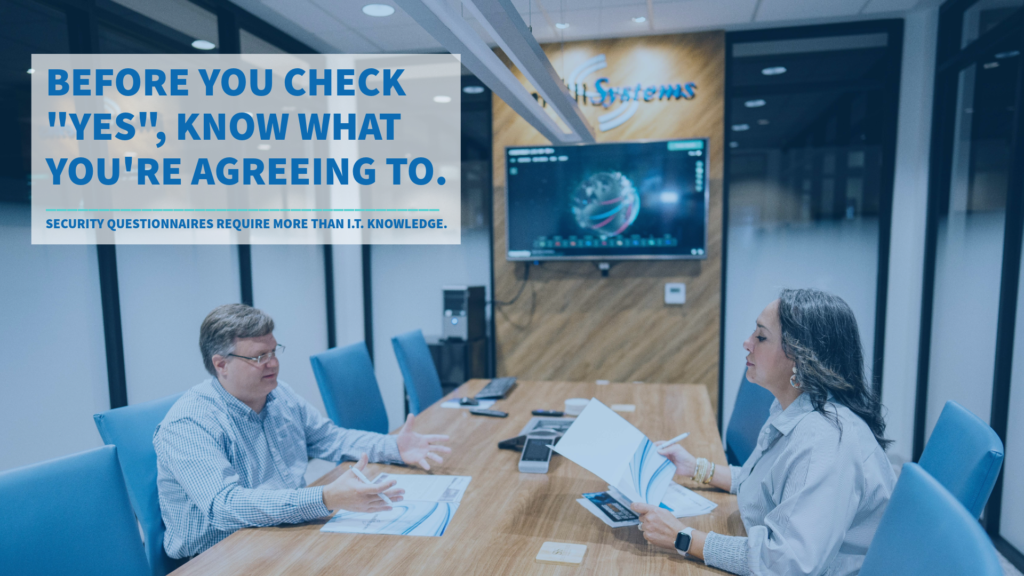
Security questionnaires are becoming a routine part of doing business. But answering them correctly takes more than IT knowledge.
Customers want assurances that their data is protected. Insurance companies want to understand your cybersecurity risks. Government contractors may need to demonstrate compliance with NIST standards. Businesses that accept credit cards may be required to complete a Payment Card Industry Data Security Standard (PCI DSS) self-assessment questionnaire.
At first glance, these questionnaires seem like something your IT team should handle.
Do you use multi-factor authentication? Is your data encrypted? Do you scan for vulnerabilities? Are security logs maintained? Do you have firewalls in place? How is sensitive information transmitted?
These are technical questions, and your IT team should certainly be involved in answering them.
But they probably shouldn’t be answering them alone.
Knowing How Technology Works Isn’t the Same as Understanding What the Question Means
IT professionals understand how your technology is configured. They can explain your firewall settings, whether multi-factor authentication (MFA) is enabled, what security software is installed, how your backups work, and whether your servers are encrypted.
But answering security and compliance questionnaires requires more than knowing what technology is in place.
You also need to understand:
- Why is this question being asked?
- Which systems, employees, processes, and data does it apply to?
- What regulatory, contractual, or security requirement is behind it?
- Does your current security measure actually meet that requirement?
- Are there exceptions that could change your answer?
- What is your business committing to when it answers “Yes”?
These are questions involving Governance, Risk, and Compliance (GRC). In simple terms, GRC helps businesses understand their responsibilities, evaluate risks, and make sure their security practices meet applicable requirements.
Misunderstanding these requirements can create problems that go far beyond your IT department.
Consider CUI and NIST Requirements
Controlled Unclassified Information (CUI) is a good example.
Your IT manager may know exactly how your organization handles encryption, access controls, endpoint security, activity logging, and network protection.
But before answering questions about CUI, there are some important things to establish.
What CUI does your business have, and where is it?
How does that information enter your organization? Who can access it? Where is it stored? Which systems process it? Can employees download it to personal devices? Is it shared with outside companies?
These answers determine what is known as your security boundary, or which systems, people, and processes must be considered when evaluating security requirements.
Without understanding that boundary, it becomes extremely difficult to know which systems and security measures should be included in your NIST-related responses.
Your company could have excellent security technology in place and still provide incorrect answers on a compliance questionnaire.
That’s an important difference.
PCI DSS Provides Another Good Example
Payment card compliance presents a similar challenge.
Imagine a questionnaire asks:
“Do you accept payment card information via email?”
An IT employee knows that your staff receives payment-related emails and answers “Yes.”
But from a PCI DSS compliance perspective, there are several questions that need to be considered first.
What information is actually included in those emails? Do they contain cardholder data, or are they simply notifications that a transaction occurred? Are payments processed through a secure third-party platform? Where and how does your organization actually accept payment information?
These details matter because PCI DSS requirements depend on how your business handles payments and which systems fall within the scope of the assessment.
Before selecting a Self-Assessment Questionnaire (SAQ), your organization needs to understand how payments are accepted and processed.
Choosing the wrong assessment or incorrectly describing your payment processes could result in unnecessary compliance obligations.
Your IT team understands the technology. A GRC professional helps determine whether you’re evaluating the right technology and answering the right questions.
A Technically Correct Answer Can Still Be the Wrong Answer
Consider another common question:
“Is sensitive information encrypted?”
Your IT administrator checks the server, confirms that encryption is enabled, and answers “Yes.”
Technically, that answer may be correct.
But what does the questionnaire mean by sensitive information?
Is it referring to customer information? Controlled Unclassified Information? Electronic Protected Health Information (ePHI)? Credit card data?
And does the question apply only to information stored on your servers, or does it also include information being transmitted, laptops, cloud applications, backups, and removable storage devices?
Suddenly, answering “Yes” isn’t quite so simple.
The IT administrator may have provided an accurate description of the server’s security. The problem is that the business answered without fully understanding what the question required or how that answer relates to its compliance responsibilities.
Your Answers Can Become Business Commitments
There’s another important reason to take security questionnaires seriously.
Your answers often go well beyond the IT department.
They may be submitted to customers, insurance companies, payment processors, banks, government agencies, prime contractors, auditors, or other third parties.
In some cases, a business owner or executive may even be required to sign or verify the responses.
That changes the significance of checking a box.
When your organization answers “Yes,” it may effectively be stating:
“Our business confirms that this security measure exists, applies to the systems and information in question, and functions as required.”
If those statements are questioned later, your organization may need to provide evidence supporting its answers.
What seemed like a simple IT questionnaire can quickly become a business risk.
IT and Cybersecurity Compliance Professionals Should Work Together
None of this means your IT team shouldn’t participate in the process. Quite the opposite.
Accurately completing security questionnaires requires both technical knowledge and an understanding of cybersecurity and compliance requirements.
Your IT team understands your technology and can provide evidence of how your security measures are implemented and maintained.
A GRC professional brings the additional knowledge needed to interpret the requirements, determine what applies to your organization, and evaluate whether those measures satisfy the questions being asked.
Your leadership team also has an important role.
Ideally, the process should work like this:
- IT team: How is this security measure implemented, and how does it work?
- GRC professional: Does it meet the applicable requirements, and which systems, people, and information does it cover?
- Business leadership: Are we confident in the accuracy of these answers and comfortable making these statements on behalf of our organization?
Each brings a different perspective, and together, they produce a more complete and defensible response.
Before You Check the Box, Make Sure You Understand the Question
Today’s security questionnaires involve much more than cybersecurity alone. They can affect regulatory compliance, contracts, insurance coverage, customer relationships, and overall business risk.
Completing one shouldn’t simply be a matter of finding someone who can answer the technical questions.
Sometimes, the most important step is asking:
“Before we answer, do we fully understand what’s being asked and what our response means for the business?”
Your IT team needs to be part of that conversation. So does someone who understands the governance, risk, and compliance implications.
IT can tell you how something is protected. A GRC professional can help determine whether that protection meets the actual requirement and whether your business can confidently stand behind its response.
How intelliSystems Can Help
At intelliSystems, we help businesses respond to security and compliance questionnaires accurately and with the documentation needed to support their answers.
We don’t replace your IT team in this process. We work alongside them to make sure their technical knowledge is considered within the proper cybersecurity and compliance context.
Our team can help with:
- Determining what’s included: Identifying which systems, employees, processes, and types of information fall within the questionnaire’s requirements, including where CUI is stored or payments are processed.
- Understanding the requirements: Interpreting questions related to NIST, CMMC, PCI DSS, HIPAA, contracts, and cybersecurity insurance.
- Selecting the right assessment: Helping your business determine the appropriate assessment process, including which PCI DSS Self-Assessment Questionnaire applies.
- Verifying your answers: Confirming that security measures are actually in place, meet the relevant requirements, and have supporting documentation.
- Identifying and addressing gaps: Documenting areas where requirements aren’t yet being met, prioritizing improvements, and developing a plan to address them.
- Preparing leadership for approval: Explaining responses in clear business language so owners and executives understand what they’re approving or signing.
The goal is simple: Make sure your business understands what it’s being asked, answers accurately, and has the evidence to support those answers.
Why Businesses Trust intelliSystems
Security questionnaires sit at the intersection of cybersecurity, compliance, contracts, and day-to-day business operations. That’s where our experience can make a difference.
intelliSystems brings:
- More than 100 years of combined experience in cybersecurity and compliance
- Professionals with respected industry certifications, including CISA, CISSP, and CISM
- Experience supporting businesses with regulated information and complex security requirements
- A combination of managed IT services and specialized cybersecurity and GRC consulting
We understand both the technology and the responsibilities businesses face when responding to security and compliance requirements.
Have a Security Questionnaire Waiting for You?
Whether it’s from a customer, insurance provider, prime contractor, or payment processor, don’t assume your IT team should complete it alone.
Before you submit your next security questionnaire, talk with the cybersecurity and compliance professionals at intelliSystems.
A brief conversation can help determine whether your responses accurately reflect your organization’s security practices and compliance responsibilities.
Contact intelliSystems to have your next security questionnaire reviewed before you submit it.
Because every “Yes” is a promise your business must be prepared to keep.