

Fall Into the Future: AI in Action | Healthcare Edition
What if your healthcare team could spend less time on paperwork, scheduling, billing, and administrative tasks, and more time taking care of patients?
What if your practice could improve efficiency, reduce operating costs, and serve more patients without constantly adding employees?
Artificial intelligence (AI) is helping healthcare organizations explore those possibilities.
And it’s not just happening in major hospitals. Doctor’s offices, urgent care centers, specialty clinics, and medical aesthetics practices are finding practical ways to use AI in their everyday operations.
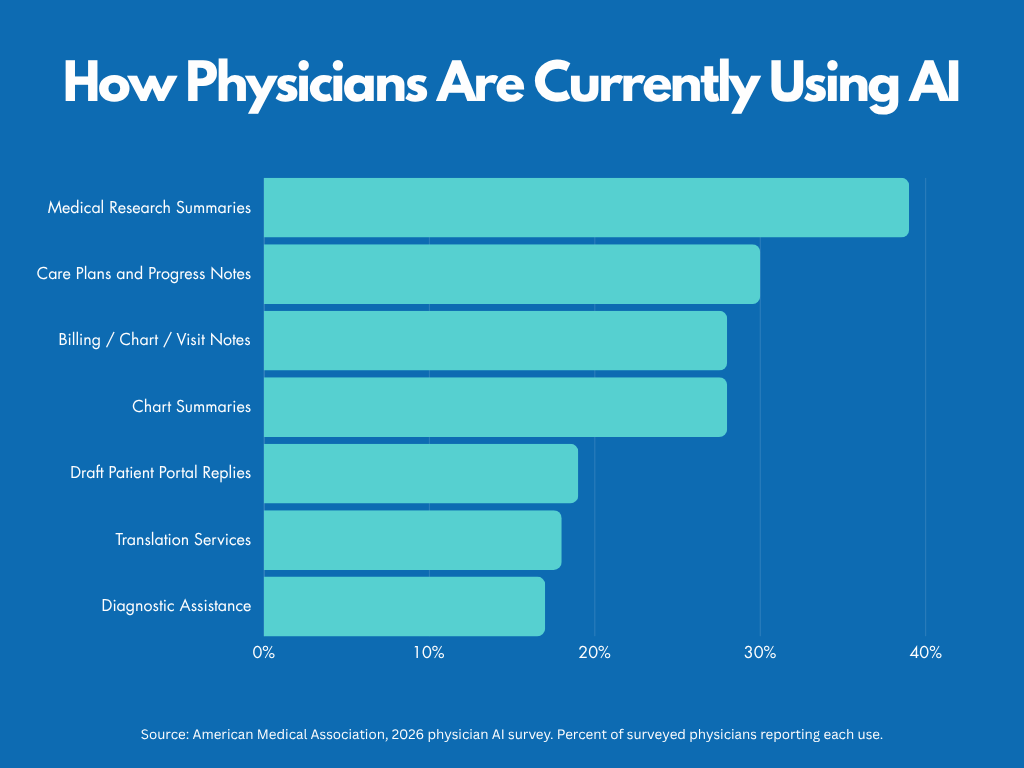
According to the American Medical Association’s 2026 physician survey, more than 80% of physicians reported using AI professionally. Among surveyed physicians, 39% were using it to summarize medical research and standards of care, while 30% were using it to help create discharge instructions, care plans, or progress notes.
But AI also introduces important questions about patient privacy, accuracy, cybersecurity, and HIPAA compliance.
So where can AI make the biggest difference, and how can healthcare organizations use it responsibly?
1. Less Paperwork. More Time with Patients.
One of AI’s most valuable applications in healthcare is reducing the administrative work that takes time away from patient care.
Healthcare professionals spend considerable time documenting visits, updating patient records, preparing instructions, and managing paperwork.
AI-enabled tools can help by:
- Drafting clinical notes from appropriately authorized patient encounters.
- Summarizing medical histories and visit information.
- Preparing draft discharge instructions and follow-up materials.
- Organizing referrals and supporting documentation.
- Converting dictated notes into structured records.
- Helping prepare routine, nonclinical correspondence.
For example, an AI documentation assistant can help a physician prepare a draft visit note during or after an appointment, reducing the time required to complete documentation manually.
The physician remains responsible for reviewing the note and confirming its accuracy before it becomes part of the patient’s medical record.
The business benefit: Less time spent documenting, reduced administrative pressure, and more opportunities for meaningful patient interactions.
For a busy medical practice, even modest time savings across multiple employees can make a meaningful difference.
2. Smarter Scheduling and Front Office Operations
An efficient medical practice depends on more than what happens in the exam room.
Appointments, reminders, phone calls, paperwork, insurance questions, and patient communications all influence the patient experience and the practice’s profitability.
AI-enabled administrative tools can help offices:
- Identify patterns in appointment cancellations and no-shows.
- Support appointment scheduling and reminder workflows.
- Draft responses to common nonclinical questions.
- Organize incoming forms and administrative requests.
- Forecast staffing and appointment demand.
- Help route calls or requests to the appropriate employees.
- Improve scheduling and follow-up processes.
Imagine an urgent care clinic that can better anticipate busy periods or a specialty practice that identifies appointment slots likely to go unused.
With the right tools and staff oversight, those insights can help the organization allocate resources more effectively.
The business benefit: Less front-office congestion, more efficient scheduling, better use of available appointments, and a smoother patient experience.
3. Faster Billing, Coding, and Insurance Workflows
Billing and insurance processes are essential to a healthcare organization’s financial health, but they can also be complicated and time-consuming.
AI-assisted revenue cycle tools can help with:
- Reviewing documentation for potential coding issues.
- Identifying missing information on claims.
- Flagging potential billing inconsistencies.
- Organizing prior authorization requests.
- Supporting claims follow-up.
- Analyzing denial trends.
- Identifying opportunities to improve collection workflows.
For example, an AI-enabled billing application may identify missing documentation before a claim is submitted, allowing staff to review and correct the issue.
These tools still require appropriate verification, especially when coding or billing decisions affect reimbursement and compliance.
The business benefit: Fewer preventable errors, less rework, more efficient revenue cycle operations, and potentially faster payment.
For healthcare practices working with tight margins, these improvements can support more predictable cash flow and profitability.
4. Better Patient Communication and Follow-Up
Patients want clear instructions, timely answers, and convenient access to information.
AI can help healthcare organizations improve communication without placing every administrative responsibility on already-busy employees.
Appropriately configured tools can assist with:
- Drafting appointment reminders.
- Preparing easy-to-understand educational materials.
- Drafting responses to patient portal messages.
- Creating follow-up communication templates.
- Translating routine information for review.
- Organizing patient satisfaction feedback.
- Identifying opportunities to improve the patient experience.
Consider a primary care practice that uses an approved AI tool to prepare draft follow-up instructions in simpler, patient-friendly language.
A qualified member of the care team can review the information before it is shared.
The business benefit: More consistent communication, fewer repetitive tasks, and a better experience for patients who want clear, timely information.
AI should not independently provide clinical advice or make patient-specific decisions beyond the intended and validated scope of the particular system.
5. Helping Healthcare Professionals Find and Organize Information
Healthcare organizations generate enormous amounts of information, from clinical records and referral documents to research, internal policies, and operational reports.
AI can help make that information easier to access and use.
Depending on the platform, potential applications include:
- Summarizing lengthy medical records.
- Organizing scanned documents and historical files.
- Extracting information from referral paperwork.
- Searching approved internal knowledge resources.
- Summarizing medical research and updated clinical guidance.
- Comparing administrative policies and procedures.
- Identifying relevant information across large document collections.
For example, a specialty clinic receiving a lengthy referral packet may use an appropriately secured AI-assisted workflow to organize the materials and prepare a summary for clinical review.
Staff can spend less time sorting documents and more time evaluating the information that matters.
The business benefit: Faster information retrieval, improved workflow efficiency, and less time spent searching through records.
However, AI-generated summaries can omit important details or misinterpret information. Clinical records and decisions must always receive appropriate professional review.
6. AI in Hospitals, Diagnostics, and Patient Care
Larger healthcare organizations are also using specialized AI technology to assist with clinical and operational challenges.
Some AI-enabled medical devices can help clinicians analyze medical images, identify findings requiring attention, or support diagnostic workflows.
Other systems can assist with operational tasks such as forecasting patient demand, reviewing utilization patterns, or identifying opportunities to improve staffing and resource allocation.
The U.S. Food and Drug Administration maintains a list of AI-enabled medical devices authorized for marketing, showing that certain AI-assisted clinical technologies are already part of regulated healthcare.
These applications differ significantly from general-purpose AI chatbots.
They require appropriate clinical validation, regulatory review where applicable, and oversight by qualified professionals.
The business benefit: Better-supported clinical workflows, improved operational planning, and opportunities to make healthcare delivery more efficient.
AI is a tool to assist healthcare professionals, not a substitute for their training, judgment, or responsibility to patients.
7. AI for Medical Aesthetics, Dermatology, and Specialty Practices
Not every valuable AI application involves diagnosing a medical condition.
Medical aesthetics offices, dermatology practices, plastic surgery clinics, and other specialty providers can use AI to improve the business side of their operations.
Examples include:
- Preparing educational content about services and procedures.
- Drafting marketing emails and social media content.
- Organizing patient inquiries and administrative follow-ups.
- Analyzing appointment demand and scheduling patterns.
- Reviewing inventory and purchasing trends.
- Preparing internal training materials.
- Summarizing general business performance reports.
- Improving customer service workflows.
For example, a medical aesthetics practice could use AI to analyze non-identifiable appointment and service data to better understand demand for certain treatments.
An office manager could also use AI to draft a monthly marketing campaign, prepare social media captions, or develop frequently asked questions for staff review.
The business benefit: More efficient marketing, better scheduling, improved utilization of resources, and more time for the patient experience.
For medical aesthetics offices, it’s especially important to distinguish general business AI tools from systems that analyze patient images, recommend treatments, or influence clinical decisions. Those applications require additional privacy, safety, and regulatory evaluation.
What Could AI Mean for Your Healthcare Business?
The benefits of AI aren’t limited to saving a few minutes here and there.
When implemented correctly, those improvements can add up across the entire organization.
For employees: Less repetitive work, reduced administrative pressure, and more time for responsibilities that require their expertise.
For patients: Smoother scheduling, more responsive communication, clearer instructions, and more attention from care teams.
For owners and administrators: Better use of staff time, lower avoidable administrative costs, improved operational visibility, and opportunities to increase capacity and revenue.
AI won’t automatically produce these outcomes. The results depend on choosing appropriate tools, implementing them properly, training employees, and measuring the improvements.
But for healthcare organizations facing staffing challenges and increasing operating costs, the opportunity is worth exploring.
The Other Side of AI: Risks Healthcare Organizations Need to Understand
AI can be useful, but it is not risk-free.
Even organizations that select reputable, approved AI tools need to understand how those systems operate and what could go wrong.
Patient Privacy and Unauthorized Disclosures
An employee who enters a patient’s medical history, test results, identifying information, or appointment details into an unapproved public AI tool may expose protected health information (PHI).
Depending on the circumstances, that disclosure could violate HIPAA.
The risk is not limited to medical records. Screenshots, appointment lists, billing information, clinical notes, and recordings may also contain PHI.
Incorrect or Misleading AI Responses
AI can generate information that sounds accurate but is incomplete, outdated, or entirely incorrect.
In healthcare, those errors can have serious consequences.
An AI tool might summarize a medical record incorrectly, omit an allergy, misunderstand a clinical note, or generate an inaccurate patient instruction.
That’s why human review is essential, particularly for anything that could affect patient care.
Cybersecurity and Data Access Risks
Even an AI system designed for business use can introduce risks if it is poorly configured.
Weak access controls, excessive user permissions, insecure integrations, compromised accounts, or insufficient monitoring can expose sensitive information.
Connecting an AI platform to electronic health records or other business systems can also create new paths for information to be accessed or shared.
Bias and Inappropriate Clinical Use
AI systems may produce different-quality results across patient populations or rely on incomplete training data.
Healthcare organizations must evaluate whether a particular tool is appropriate for its intended use and whether its outputs could introduce bias or affect clinical decisions.
Overreliance on Automation
AI can make tasks easier, but employees should not assume it is always correct.
Automatically generated documentation, scheduling actions, billing recommendations, and patient communications need appropriate safeguards and review.
The goal should be to improve the work of healthcare professionals, not eliminate accountability.
Is Using AI a HIPAA Violation?
No. AI use itself is not a HIPAA violation. But using AI in ways that improperly disclose, access, store, or process protected health information can create HIPAA compliance problems.
Healthcare organizations subject to HIPAA must continue meeting their obligations under the Privacy, Security, and Breach Notification Rules when adopting AI technology.
For example, if an AI vendor creates, receives, maintains, or transmits PHI on behalf of a covered healthcare organization, a HIPAA-compliant Business Associate Agreement (BAA) will generally be required, along with other applicable safeguards.
A BAA alone is not enough.
Healthcare organizations also need to understand how the technology uses information, where data is processed and stored, who has access, whether it is retained or shared, and how security is maintained.
They must also consider whether the proposed use of PHI is permitted, whether access complies with applicable minimum-necessary requirements, and whether appropriate risk analysis has been completed.
Important: A platform that advertises strong encryption or enterprise security is not automatically suitable for processing PHI. And purchasing a tool marketed as HIPAA-compliant does not automatically make an organization’s use of that tool compliant.
How to Use AI More Safely in Healthcare
Before implementing AI in a medical practice, clinic, or hospital, start with these steps.
1. Identify appropriate uses. Begin with everyday business tasks that offer measurable benefits and relatively limited risk, such as drafting general policies, creating marketing materials, or organizing non-sensitive operational information.
2. Evaluate and approve your AI tools. Understand the vendor’s privacy policies, data handling practices, security controls, integrations, retention policies, and subcontractors. Obtain an appropriate BAA before permitting a vendor to handle PHI when one is required.
3. Conduct a security risk analysis. Evaluate how the new technology may affect the confidentiality, integrity, and availability of electronic protected health information.
4. Establish access and usage controls. Give employees access appropriate to their roles, use secure authentication, and monitor how the platform is being used.
5. Create an AI usage policy. Define approved tools, permitted information, acceptable uses, prohibited activities, and procedures for reviewing AI-generated content.
6. Train your employees. Make sure everyone understands how to use AI responsibly, recognize inaccurate outputs, and protect sensitive information.
7. Keep humans involved. Require appropriate review of clinical documentation, patient-facing medical information, billing decisions, and other consequential outputs.
8. Review and improve. Monitor security, evaluate outcomes, and update policies as the technology and your organization change.
AI adoption should be part of a broader technology and cybersecurity strategy, not an isolated software purchase.
You Don’t Have to Figure Out Healthcare AI Alone
For many healthcare organizations, the biggest challenge isn’t recognizing AI’s potential. It’s knowing which tools to use, how to implement them, and how to protect patients and the business along the way.
That’s where IntelliSystems can help.
Since 1993, IntelliSystems has helped businesses throughout Georgia and South Carolina manage their technology, improve operations, and protect sensitive information.
Our team supports healthcare organizations with IT management, cybersecurity, security assessments, compliance-related technology guidance, and consulting.
We can help you evaluate AI opportunities, understand potential security concerns, develop appropriate controls, and implement technology that supports your organization’s goals.
One AI Platform. More Capabilities. Greater Control.
IntelliSystems also offers an exclusive-to-IntelliSystems business AI platform designed to make AI more accessible and manageable for organizations.
Instead of juggling multiple individual AI subscriptions, your team can access multiple leading large language models (LLMs) through one centralized platform.
Features include:
- One companywide subscription: Simplify access to multiple AI models for your organization.
- Centralized controls: Manage employee access and permitted AI use.
- Security and usage management: Gain greater oversight of how employees interact with AI.
- Reporting: Understand adoption and usage across your organization.
- Built-in training: Help employees learn how to use AI more effectively and responsibly.
- Healthcare-focused workflows: Give your team a practical starting point for appropriate medical industry tasks.
- Local consulting and support: Get help selecting, configuring, and introducing AI into everyday operations.
Packages are tailored to your organization’s needs and include defined consulting and support.
For organizations handling protected health information, IntelliSystems can help assess proposed uses, required agreements, technical safeguards, and whether the platform’s capabilities are appropriate.
Ready to Put AI to Work in Your Healthcare Organization?
Whether you’re interested in reducing administrative workloads, improving patient experiences, exploring AI opportunities, or reviewing the security of the tools your employees already use, IntelliSystems is here to help.
Schedule a Conversation with IntelliSystems.
Ask about our limited availability of free one-month AI platform trials.
Explore More Ways AI Is Changing Business
This article is part of IntelliSystems’ Fall Into the Future: AI in Action series, exploring practical ways businesses across different industries are using artificial intelligence to save time, improve productivity, and work smarter.
Discover how AI is making a difference in legal services, construction, manufacturing, accounting, and more.
[Explore the Fall Into the Future: AI in Action Series]
This article is for general educational purposes and does not constitute legal, medical, or regulatory advice. Healthcare organizations should evaluate their specific HIPAA obligations, applicable laws, vendor agreements, and intended AI uses before implementing new technology.
Frequently Asked Questions About AI in Healthcare
How is AI being used in small medical practices?
Small medical practices can use AI to assist with scheduling, documentation, billing, patient communications, medical research summaries, and administrative workflows. These applications can help reduce repetitive tasks and improve the patient experience without requiring a large IT department.
Is AI HIPAA compliant?
AI technology is not automatically HIPAA compliant. Whether it can be used in a HIPAA-compliant manner depends on how it handles protected health information, the vendor’s agreements and safeguards, the organization’s configuration, and the specific use case. A Business Associate Agreement may be required when a vendor handles PHI on behalf of a covered organization.
Can healthcare employees use ChatGPT or other public AI tools?
Employees can use approved general-purpose AI tools for appropriate tasks, such as drafting generic communications or organizing non-sensitive information. They should not enter patient-identifiable information into unapproved platforms. Any system that will handle PHI must undergo an appropriate privacy, security, and compliance review first.
Can AI help healthcare practices become more profitable?
AI can support profitability by reducing administrative workload, improving scheduling, identifying preventable billing errors, and helping staff work more efficiently. Results depend on the cost of the technology, how it is implemented, and whether it produces measurable improvements.
What are the biggest risks of using AI in healthcare?
Major risks include unauthorized disclosure of patient information, inaccurate or misleading outputs, inappropriate clinical use, weak cybersecurity controls, biased results, and employees relying too heavily on automated recommendations. Healthcare organizations should manage these risks through approved tools, security assessments, employee training, and human oversight.