
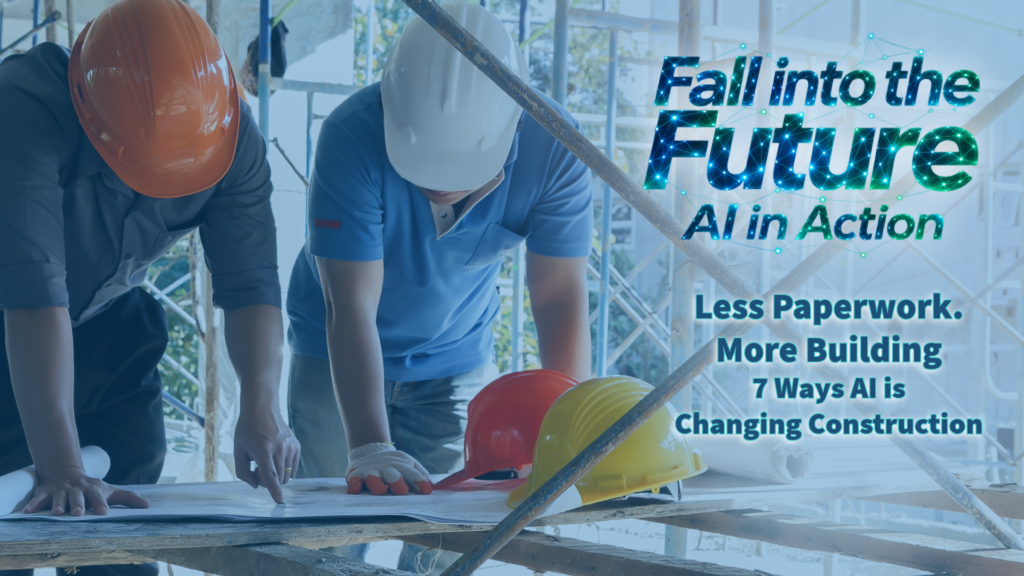
Fall Into the Future: AI in Action | Construction Industry Edition
What if your project managers could spend less time chasing down information, your estimators could prepare bids faster, and your office staff could get through paperwork without constantly falling behind?
What if your construction company could take on more work without having to add more employees just to manage it?
Artificial intelligence (AI) is creating opportunities to do exactly that.
From estimating and scheduling to reviewing blueprints, preparing jobsite reports, and managing everyday business operations, AI is helping construction companies reduce repetitive work and make better use of their employees’ time.
And it’s not just for large national contractors. Small and midsize construction companies, general contractors, specialty trades, and builders can benefit, too.
According to the Associated General Contractors of America’s 2026 Construction Hiring and Business Outlook, 61% of surveyed contractors reported using AI or planning to increase investments in it, up from 44% the previous year.
The technology is becoming an important part of how construction businesses operate. The challenge for many companies is knowing where to start and how to use it effectively.
Here are seven practical ways AI can help construction companies work smarter.
1. Faster Estimating, Takeoffs, and Bidding
Preparing an accurate construction estimate requires time, attention to detail, and a solid understanding of materials, labor, and project requirements.
Estimators often spend hours reviewing plans, calculating quantities, comparing costs, and preparing proposals.
AI can help simplify parts of that process.
Depending on the technology used, AI-assisted estimating tools can help:
- Identify and organize information from project plans.
- Assist with material quantity takeoffs.
- Compare project specifications.
- Identify potential omissions or inconsistencies.
- Analyze historical project costs.
- Organize supplier quotes.
- Prepare draft bid summaries and proposals.
For example, a commercial contractor preparing a proposal could use specialized AI-assisted technology to help organize project requirements and generate preliminary quantities for review.
The estimator can then verify the information, account for project-specific conditions, and finalize the bid.
The business benefit: Less time preparing estimates, greater consistency, and more opportunities to pursue additional projects.
For construction companies with limited estimating staff, getting more done without adding employees can make a meaningful difference.
2. Smarter Project Scheduling and Resource Planning
Construction projects rarely go exactly as planned.
Weather, material delays, subcontractor availability, equipment issues, and unexpected site conditions can all affect a project’s schedule.
Keeping everything coordinated takes time.
AI-assisted scheduling tools can analyze project information to help teams:
- Identify potential scheduling conflicts.
- Evaluate the effects of proposed changes.
- Recognize activities at risk of delay.
- Compare scheduling alternatives.
- Forecast resource requirements.
- Organize subcontractor schedules.
- Analyze historical project performance.
Imagine a project manager coordinating several subcontractors across multiple jobsites.
Instead of manually reviewing every schedule update, AI can help highlight potential conflicts or activities that need attention.
The project manager can then evaluate the information and coordinate the necessary adjustments.
The business benefit: Better planning, improved use of resources, fewer scheduling surprises, and potentially less costly downtime.
AI won’t eliminate construction delays, but it can help teams recognize potential problems earlier.
3. Finding Information Faster in Blueprints, RFIs, and Project Documents
Every construction project generates a tremendous amount of information.
Blueprints, specifications, contracts, requests for information (RFIs), submittals, change orders, meeting notes, and emails can quickly become difficult to manage.
And when someone needs a specific answer, finding it can take longer than it should.
AI-powered document analysis and search tools can help construction companies:
- Search large collections of project documents.
- Summarize lengthy specifications and contracts.
- Extract key dates, requirements, and obligations.
- Locate information within approved project records.
- Help prepare draft RFIs.
- Organize submittals and change orders.
- Summarize project meetings.
- Identify potentially conflicting information.
For example, a project manager trying to locate a specific requirement could use an appropriately configured AI system to search approved project files and identify relevant information.
Instead of spending an hour searching through folders, the project manager may be able to find the information much faster.
The business benefit: Less time searching, faster communication, and fewer delays caused by missing information.
AI-generated answers still need to be verified against the latest approved documents. But used properly, AI can help make project information significantly easier to manage.
4. Less Paperwork and Better Jobsite Reporting
Ask a superintendent or project manager how much time they spend on paperwork, and the answer is probably more than they’d like.
Daily logs, inspection notes, progress reports, meeting summaries, and project updates are essential, but they can take time away from managing the actual work.
AI can help reduce that burden.
Practical applications include:
- Turning voice notes into draft daily reports.
- Summarizing jobsite meetings.
- Organizing project photos and descriptions.
- Preparing progress updates.
- Converting handwritten notes into searchable documents.
- Creating lists of outstanding tasks.
- Drafting routine project communications.
Imagine a superintendent recording a few notes at the end of the workday.
Using an approved AI workflow, those notes could be transformed into a structured draft report documenting the day’s activities, completed work, outstanding issues, and upcoming priorities.
After reviewing the information, the superintendent can finalize the report.
The business benefit: Less time completing paperwork, more consistent documentation, and more time available for managing crews and keeping projects moving.
For smaller construction companies, even simple applications like summarizing meetings or preparing reports can provide meaningful time savings.
5. Identifying Potential Problems Before They Become Expensive
In construction, small mistakes can quickly become expensive problems.
A missed specification, unresolved RFI, delayed material delivery, or overlooked quality issue can affect the schedule and the budget.
Some specialized AI systems can analyze project information and historical data to help identify patterns that may indicate risks.
Potential applications include:
- Flagging unresolved project issues.
- Identifying patterns associated with delays.
- Reviewing project documentation for inconsistencies.
- Prioritizing quality concerns.
- Analyzing historical project performance.
- Identifying potential cost overruns.
- Supporting jobsite risk monitoring.
For example, AI-assisted analysis may help a project manager recognize that several outstanding issues are affecting an upcoming project milestone.
Rather than discovering the problem after the schedule slips, the team has an opportunity to address it sooner.
The business benefit: Earlier awareness of potential problems, better project oversight, and more opportunities to protect schedules and profitability.
AI should support the judgment of experienced construction professionals, not replace required inspections, engineering decisions, or safety procedures.
6. Improving Communication with Clients, Subcontractors, and Employees
Construction depends on communication.
Project owners want updates. Subcontractors need answers. Employees need schedules and instructions. Office teams need information from the field.
Keeping everyone informed can feel like a full-time job.
AI can help simplify everyday communication by:
- Drafting project updates for clients.
- Summarizing meetings and phone conversations.
- Preparing routine subcontractor correspondence.
- Organizing action items and follow-ups.
- Creating employee training materials.
- Drafting professional proposals and presentations.
- Helping prepare internal announcements.
- Translating routine communications for review.
Imagine a project manager finishing a meeting with a client and several subcontractors.
Instead of spending another hour preparing a recap, an approved AI tool could help organize the notes into a clear summary with action items, responsibilities, and next steps.
The project manager reviews the information and sends it out.
The business benefit: Faster communication, less administrative work, fewer missed details, and more responsive service for customers.
Many construction companies can start using AI for these everyday tasks without completely changing how their businesses operate.
7. Making the Office More Efficient and Profitable
AI isn’t just useful on the jobsite.
Construction companies also have office teams managing accounting, purchasing, payroll, hiring, marketing, customer relationships, and other responsibilities.
For a small or midsize contractor, those responsibilities may fall on just a handful of employees.
AI can help take some of that repetitive work off their plates.
Examples include:
- Organizing invoices and purchase orders.
- Summarizing financial and operational reports.
- Drafting customer correspondence.
- Preparing job descriptions and hiring materials.
- Creating marketing content and project descriptions.
- Organizing internal procedures.
- Developing employee training documents.
- Helping prepare business presentations and proposals.
For example, an office manager could use AI to turn a lengthy meeting into a short summary, prepare a customer newsletter, or draft an internal process document.
More specialized, appropriately integrated technology may also help accounting teams analyze job costs, identify potential discrepancies, and review financial trends.
The business benefit: Reduced administrative workloads, more consistent operations, and more time for employees to focus on activities that help the business grow.
For construction companies trying to manage overhead, improving productivity can be just as valuable as adding another employee.
What Could AI Mean for Your Construction Company?
AI isn’t going to replace the expertise of an experienced estimator, superintendent, project manager, or skilled tradesperson.
But it can help those employees get more done with less repetitive work.
And the benefits can extend throughout the business.
More productivity: Employees spend less time on paperwork, searching for information, and completing routine administrative tasks.
Better project management: Teams can organize information, improve communication, and recognize potential problems earlier.
Improved profitability: Reducing unnecessary administrative work and avoidable mistakes can help protect margins.
Greater capacity: More efficient processes may allow your existing team to support additional work without increasing overhead at the same rate.
Less stress: Owners and managers can spend less time tracking down answers and more time leading their teams and growing the business.
The key is identifying where AI can deliver meaningful results, rather than adding technology just for the sake of having it.
What Are the Risks of Using AI in Construction?
AI can make work easier, but it’s important to understand what it can and cannot do.
One of the biggest risks is relying on information that sounds accurate but isn’t.
AI can misinterpret project specifications, overlook important details, generate incorrect calculations, or provide outdated information.
In construction, those mistakes can affect costs, schedules, contractual obligations, and even safety.
There are also cybersecurity and confidentiality concerns.
Construction companies regularly handle sensitive information, including:
- Client contracts and project plans.
- Proprietary pricing and bid information.
- Employee and financial records.
- Confidential customer information.
- Project documentation subject to contractual or regulatory security requirements.
Entering that information into an unapproved public AI tool could expose your business to unnecessary risks.
For contractors working on government or defense-related projects, additional data protection and cybersecurity requirements may also apply.
How Can You Use AI More Safely?
Before introducing AI into your construction business:
- Use approved AI tools. Understand how your information is stored, shared, and protected.
- Establish company guidelines. Define what employees can use AI for and what information they can enter.
- Protect sensitive information. Manage permissions and avoid exposing confidential project or financial data.
- Verify important outputs. Have qualified professionals review estimates, specifications, contracts, schedules, and safety-related information.
- Train your team. Make sure employees understand both the benefits and the limitations of AI.
- Monitor usage. Maintain visibility into how employees are using AI and identify opportunities for improvement.
You don’t have to navigate these decisions alone.
How Can Your Construction Company Start Using AI?
You don’t need to be a technology expert or have a large IT department to begin taking advantage of AI.
And you don’t have to figure out which tools to use on your own.
IntelliSystems helps construction companies identify practical AI opportunities, select appropriate solutions, and put the technology to work.
We can help your business:
- Identify opportunities: Determine which repetitive tasks and workflows could benefit from AI.
- Choose the right solutions: Evaluate your company’s needs and identify appropriate AI capabilities.
- Implement AI securely: Establish access controls, protect sensitive information, and configure the technology.
- Train your employees: Help your team understand how to use AI effectively and responsibly.
- Build better workflows: Explore ways to simplify administrative processes and improve productivity.
- Plan for growth: Identify additional opportunities as your employees become more comfortable using AI.
Whether your biggest challenge is managing paperwork, improving communication, or getting more done with your existing team, IntelliSystems can help you develop a practical approach.
One AI Platform. More Capabilities. Greater Control.
What if your construction team could access multiple leading AI models without managing separate subscriptions, accounts, and applications?
IntelliSystems offers a secure business AI platform that brings multiple large language models (LLMs) together in one centralized environment.
With one companywide subscription, your employees can access AI capabilities to help with everyday tasks such as drafting reports, summarizing meetings, organizing documents, preparing communications, and developing business materials.
The platform includes:
- One companywide subscription: Simplify access to multiple AI models for your business.
- Centralized security and usage controls: Manage employee access and help protect company information.
- Reporting: Gain visibility into how AI is being used throughout your organization.
- Built-in training: Help your employees learn to use AI more effectively.
- Preset workflows: Give employees a practical starting point for common business tasks.
- Local consulting and support: Get help selecting, configuring, and introducing AI into everyday operations.
Packages are customized to your company’s needs and include defined consulting and support.
For more specialized applications, such as blueprint analysis, quantity takeoffs, or predictive project scheduling, IntelliSystems can also help evaluate the requirements and identify an appropriate implementation approach.
You get a local technology partner who can help your team understand where AI makes sense, how to use it, and how to protect your business along the way.
Ready to Put AI to Work for Your Construction Company?
Construction companies have enough to manage without spending unnecessary hours on paperwork, administrative tasks, and searching for information.
AI can help relieve some of that pressure.
Since 1993, IntelliSystems has helped businesses throughout Georgia and South Carolina make better use of technology. Our award-winning team provides local IT support, cybersecurity, consulting, and emerging technology solutions designed to keep businesses productive and secure.
Now, we’re helping construction companies explore how AI can make everyday operations easier.
From identifying opportunities and implementing solutions to training employees and managing security, IntelliSystems is your local partner for putting AI to work.
Your Team Has Projects to Build. Let AI Help with the Busywork.
Frequently Asked Questions About AI in Construction
How is AI being used in construction today?
Construction companies are using AI to help with estimating, scheduling, project documentation, jobsite reporting, communication, risk analysis, and administrative work. Some tasks can be handled with business AI tools, while specialized applications require more advanced technology.
Can small construction companies benefit from AI?
Absolutely. Small and midsize contractors can start with everyday tasks such as drafting proposals, summarizing meetings, preparing reports, and organizing information. AI can help smaller teams work more efficiently without requiring a large IT department.
Can AI help construction companies save money?
AI can help reduce repetitive work, improve project coordination, and identify potential problems earlier. These improvements can lower administrative costs and help protect project profitability. Actual savings depend on how the technology is implemented and used.
Can AI review construction blueprints?
Certain specialized AI systems can assist with analyzing construction drawings, extracting information, and preparing quantity takeoffs. However, these capabilities require appropriate software and human verification. AI should not replace professional engineering judgment or approved construction documents.
How can IntelliSystems help construction companies use AI?
IntelliSystems helps construction companies identify practical AI opportunities, evaluate solutions, implement appropriate technology, establish security controls, and train employees. We also offer a secure business AI platform that provides access to multiple AI models through one companywide subscription.
Explore More Ways AI Is Changing Business
This article is part of IntelliSystems’ Fall Into the Future: AI in Action series, exploring practical ways businesses across different industries are using artificial intelligence to save time, improve productivity, and work smarter.
From healthcare and legal services to manufacturing and accounting, discover what AI could do for your business.